Monday, June 15, 2009

Giving to Operation Breakthrough


On Friday, our Executive Fellows class spent the afternoon at Operation Breakthrough, a safe haven for 670 under-privileged kids that live in our city. Seeing the place and hearing its leader, Sister Berta, is somewhat transformative for those of us who rarely experience the challenges these kids (and their parents) face.


What I also learned from our session is how much our executive MBA students and faculty have already contributed to this Kansas City organization. First, 2001 Executive Fellow alum Gary DeRigne has been an essential liaison and adjunct professor in leading student consulting projects. We some of the fruits of these projects on our visits -- e.g., a fellows team a couple of years ago created career information graphics that are still prominently displayed in the room where teens hang out.


Second, two fellows students who graduated last month took the time to come and present the projects their teams worked on this past year. And they were significant projects:


  • Audrey who operates a cafe across the street from the Capitol building in Jefferson City made the 2-hour drive to talk about the political action project her team led this past year. She reported that progress had been made on a bill that impacts poor families and child care but that the job had not been completed.

  • Jeff talked about how his team's project led to the creation of 4 summer internships at KCP&L this summer. That is, 4 teens affiliated with Operation Breakthrough's services now are working this summer to gain real work experience (and these are paying jobs).

  • We also learned of the other projects done this past year by our fellows students.

It is a wonderful cause -- Gary, Audrey, and Jeff came entirely because of their commitment to the cause -- and I salute all our students over the years who have contributed. Sister Berta told me on Friday we should monetize these contributions. Maybe she was exaggerating that it was probably worth $250,000 . . . but whatever the cost it was worth it.

Monday, June 8, 2009

Greenland Up?


The late management guru, Peter Drucker, wrote that we know only two things about the future:
  • It cannot be known.

  • It will be different from what exists now and from what we now expect.

In business this is evident all the time. Three years ago, Dell was sitting pretty as its main competitor H-P was trying to recover from a messy "divorce" from its CEO and tyring to figure out how to overcome a disadvantageous cost position. Today, Dell is trying to figure out how to come out from under weakening demand in a mature PC business and changing consumer preferences for buying those computers (one that actually has favored H-P). Business Week reports Dell is now desparately looking to acquire companies that can get it into new growth businesses.


Drucker's statement works for economies and countries as well. It was a great irony to learn (sometime in my youth or adulthood) that despite their names and their latitudes, Iceland was a land of opportunity while Greenland was a desolate mass of ice. Reagan and Gorbachev held their famous summit in Reykjavik, Iceland (Greenland was never an option). Iceland was home to many banks and the climate is considered quite balmy compared to other northern exposures.


Yet, today The Business Week asks if Greenland is now the "next emerging economy"? Ruled by Denmark, the large island is about to be granted a right to self-government for the 56,000 people that live there (mostly native inuits). It seems Greenland has some resources of value today -- swift rivers (translated to hydroelectric power) and lead and zinc. The low power costs are important to businesses like computer storage companies who must store servers in cool, regulated places. Conversely, Iceland has suffered mightily from the financial meltdown . . . Even for countries fortunes change because the future always changes.


Ironically, Greenland's surge will be further helped by global warming; as ice melts, rivers run faster and now-covered resources (i.e., lead and zinc) become accessible. I suspect our race to reverse global warming effects will have all kinds of consequences--intended and unintended.

Friday, June 5, 2009

GM Bail Out

It seems we live in extraordinary times when the government takes on a 70% ownership of a for-profit enterprise. Actually, there is lots of precedent for government intervention from all administrations. Reagan "bailed out" Harley Davidson by giving them loans and favorable tariffs.

Taking on such a large equity stake, however, creates added potential problems related to simple management principle of allocating resources. Companies operate with limited resources -- they must make choices and prioritize. Very effective units within companies (or even whole companies) often pardoxically succeed BECAUSE they have fewer resources. Japanese auto companies in the 1950s could not compete with Detroit's vast production lines that took up lots of space (not available in the island country) forcing them to create lean manufacturing, which turned out be a great innovation and advantage.

Now consider a small unit inside a company. If it is managed well, someone has line authority of this unit with some kind of budget. And the good managers figure out how to get results with the resources they have. (Several baseball teams over the last twelve years have proven that they can win with significantly less money than some of their competition because they are more resourceful and innovative.) Now imagine the CEO parachuting in to run a unit -- he or she will most likely put more resources to bear not necessarily because they are needed (many times they are because the unit is being starved) but because he or she can do it. They just have easier access to people, cash budgets, etc. They have power, which includes easier access to resources.

Now consider President Obama and Congress (and every other VIP who will assert ownership) and the irresistable tempation to meddle and eventually pouring more resources to the problems rather than manage it. Forget the many unintended diasasters to the market by having a government player using policy and pusestrings to create market winners, the fundamental problem is that it will be too easy to throw $$ at problems that need to be managed with innovative ideas.

And here is one person's rendition of other unintended consequeces, as well.

Monday, June 1, 2009

Best place to Work?


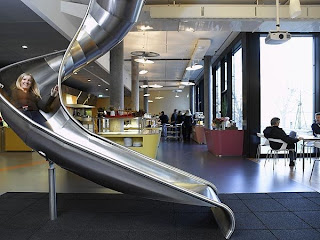
As you know, Google has had tremendous success over the last several years, becoming a huge enterprise on the strength of its primary internet search business. A colleague sent me some pictures of some of the perks Google employees enjoy in their workplace. They have areas where professional masseurs work, pool tables for relaxation, exotic cafeterias or as pictured above relaxation rooms with massage chairs in the ambience of stocked aquariams.


If that doesn't get you excited, how about private cabin areas for you to sneak away to take care of personal affairs . . . pictured to the right.


It actually, looks a little creepy to me and signals for sure a bit of hubris that so often takes hold of successful companies. Nearly always, however, these companies eventually find themselves struggling to control costs in the face of increasing competition, leading to layoffs . . . and these perks won't seem so neat when you are out of a job. In fact, Google may eventually have to repurpose another nifty perk -- slides for quick access to different floors -- so that those laid off can slide right out the door!

Friday, May 22, 2009

Dueling Speeches

Yesterday was an almost historic day in that two heavyweights in terms of stature "debated" the issue of counter-terroism policy -- Obama vs. Cheney. I won't get into who won, which is mostly dependent on one's ideological persuasion, but I found interesting one part of the argument taken up by both men and it reveals the inherent weakness of political solutions.

Having watched parts of Obama's speech and read the transcript of Cheney's, I think Gerald Seib of the WSJ identified the most interesting contrast of the two approaches ("Two Approaches on Gitmo, No Middle Ground"). As Seib notes, Obama made a clear attempt to strike a middle ground and Cheney was very clear that on this issue such a posture is foolish. Specifically, Cheney said, "The administration seems to pride itself on searching for some kind of middle ground in policies addressing terrorism," he said. "They may take comfort in hearing disagreement from opposite ends of the spectrum....But in the fight against terrorism, there is no middle ground. And half-measures keep you half-exposed."

It is quite natural for the sitting president to try and take a middle ground -- he is trying to appeal to the greatest number of voters and he must work in a political process. Yet, Cheney's criticism gets at the heart of the real weakness of compromise. Compromise always leads to sub-optimal solutions. That is why when new legislation is passed some of those that sign onto the bill admit it is not perfect. In business, executives don't have to sub-optimize; that is, they can pursue policies that create "win" situations rather than "win/win." I can't imagine Steve Jobs at Apple, setting competitive policy with any other intention than "winning" against its competitors.

The Bush administration got excoriated for pushing the envelope on counter-terrorism policy in part because they seemed to obfuscate the purposes and the details. It is clear the reason they did this--often to their own disadvantage--is that they were trying to play a "win" strategy while presenting it in a political context, which demands "win/win" or compromise.

It's a worthwhile question: Should we (the U.S.) compromise or stake out a middle ground on the issue safety from terrorism? Should politicians try to act like they are operating a business? Can they? Finally, should we in wars provide Executives the power to execute strategies that bypass inherent weakness of compromise?

Wednesday, May 20, 2009

Finding Business Wisdom

CEOs of large corporations get a lot of play in the business press. People like Jack Welch, former head of General Electric, have become iconic; others like Ken Lay or Bernie Ebbers infamous. Most recently, the CEOs of the automobile manufacturers have been in the news trying to save their companies. Based on this interview with an unknown car dealer named Jack Fitzgerald, Congress (since we now own GM) would be well advised to listen to people with better knowledge of the business.

Fitzgerald owns 5 Chrysler dealerships and notes the commandment that "thou shalt never dis the manufacturer" but plows right into doing just that. You will learn more about the industry in his 5 minutes than most full-length articles. Here are some of his gems:
  • Dealerships are not overhead to the car companies -- the dealerships are independently owned (usually based on personal borrowings of the dealer owner). Even without selling any cars, the manufacturer makes money on the dealership just through fees.
  • There are in the neighborhood of 100 million GM and Chrysler cars on the road. While new car sales are down and killing the company, there are still a lot of used cars sold. Dealerships are still the ones to service them. There are more cars on the road today (150 million), not less.
  • When Fitzgerald bought his first Chrysler dealership, 23% of the recommended cars by Consumer Reports were Chrysler. Today it is 6%. The number for GM: 44% and 8%, respectively. Fitzgerald rolls these numbers out without notes or thought -- he simply knows them.
  • His prescription for the business: We have 100 million cars out there and we need to take care of them and have something of quality to offer them for a new car.

I will bet that President Obama has no one on his staff as smart about the automobile business as Jack Fitzgerald. The more credentialed suspects likely to congregate in government circles might want to listen to Mr. Fitzgerald.

Wednesday, May 13, 2009

Confidence in the Product

I have been away for a few weeks recovering from surgery that has affected my ability to sit down -- and type a blog.

One way to advertise your product is to use it. I have always been troubled by politicians that promote and encourage public schools only to send their children to private ones. Such action is an admission that the product they are peddling is not all that good.

As the school year is down to the last few days, I must share my use of the product I am part of -- a Rockhurst eduction. My daughter has just completed her freshman year (literally just finished an hour ago) and I have re-learned some things I should have already known.

First, faculty in a variety of departments -- science, math, psychology, English, communication, history, and theology -- have been excellent. This year I have become a silent admirer of the work of Dr. Kovich, Dr. Felzien, Dr. Shorter, Dr. Bicek, Dr. Madison, Dr. Samonte, Dr. Miller et al. They know their subjects, but are focused on students first.

Second, there are organizations and support systems for students to find how they fit. Dr. Martin's work with the Honors Program is one example. Even though my daughter commuted this year -- which can be disconnecting -- she was able to plug into important campus supports as they were needed.

I am gratified that she enjoys going to school where her father works -- probably her feeling is in part because she knows she won't take any of my courses.