Last Friday I spent all day driving to northwestern Iowa and back to bring one of my daughter's home from a camp. Besides just missing a storm that blew through Omaha, we noticed many of the crop fields in high water. It is not news that Iowa has been hit hard by flooding--though the most severe problems are east of where we drove. One thing that I thought of looking at those corn fields was the rising price of corn.
Well it turns out that the dire reports of corn shortages may have been vastly overstated. Today's Wall Street Journal reports that while there has been signficant crop damage, estimates did not account for increased planting this year from last. An innocent mistake. Yet, that misinformation caused the price of corn to skyrocket (and plummet again based on this news).
No doubt in the market there will be winners and losers because of this -- I sure would like to have sold corn short! Still, this kind of news has business people pulling their hair, especially if they insist they can make data certain decisions.
Monday, June 30, 2008


Friday, June 13, 2008
Commodity Prices
I spent the last week with managers from several different industries--agriculture, steel, large industrial pipes, newspapers, technology services. These participants confirm the fact that commodity prices in addition to oil are increasing steeply. Biofuels and overall world demand is driving up the cost of grains. Skyrocketing steel costs are driving up costs for anyone using steel (gone up 75% in just last year according to one of these managers). Newsprint is also going up, impacting newspapers.
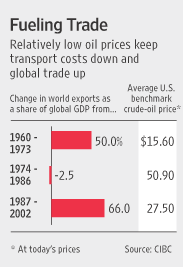
Today's Wall Street Journal reports that soaring transportation costs (along with other factors) is starting to bring manufacturing back to the U.S. If soaring fuel costs have this kind of impact (see chart), other chain reaction impacts will occur that will be upsetting to consumers and a number of industries. Commodity prices are causing havoc.
But are they? Commodities tend to be driven by supply and demand. These commodities that are going up are feeling supply and demand pressures (either increased demand, sagging supply, or both). When there is demand pressure, prices naturally go up, which incents companies to increase supply. So these price increases are actually a beneficial effect of supply and demand. In an environment where business is allowed to operate freely (relatively speaking) forces will soon emerge that increase supply or find less expensive substitutes. Also, consumers will change their habits to decrease demand as they have more trouble paying the high price.
And it does hurt a lot of companies operating in businesses using the commodities. But it also opens opportunities for businesses who identify market needs and find ways to exploit them. Of course, politicians will get involved and rarely do they make things better in the long run. So watch in this next cycle of the elections for politicians to pander on the rising commodity prices, promising to fix the short-term pain that is part of business. But don't bet any of their solutions will be effective . . . just hope they do little harm.

Today's Wall Street Journal reports that soaring transportation costs (along with other factors) is starting to bring manufacturing back to the U.S. If soaring fuel costs have this kind of impact (see chart), other chain reaction impacts will occur that will be upsetting to consumers and a number of industries. Commodity prices are causing havoc.
But are they? Commodities tend to be driven by supply and demand. These commodities that are going up are feeling supply and demand pressures (either increased demand, sagging supply, or both). When there is demand pressure, prices naturally go up, which incents companies to increase supply. So these price increases are actually a beneficial effect of supply and demand. In an environment where business is allowed to operate freely (relatively speaking) forces will soon emerge that increase supply or find less expensive substitutes. Also, consumers will change their habits to decrease demand as they have more trouble paying the high price.
And it does hurt a lot of companies operating in businesses using the commodities. But it also opens opportunities for businesses who identify market needs and find ways to exploit them. Of course, politicians will get involved and rarely do they make things better in the long run. So watch in this next cycle of the elections for politicians to pander on the rising commodity prices, promising to fix the short-term pain that is part of business. But don't bet any of their solutions will be effective . . . just hope they do little harm.
Friday, June 6, 2008
Gino Fever

The summer schedule allows me to do more reading -- and catch interesting articles such as the one in today's Wall Street Journal. On the back of the the Marketplace section is the story of Boston's new craze with an anonymous character from a 1977 American Bandstand video - you can find the article here (and don't need to be a basketball fan to enjoy).
Breifly, this video clip is being shown at Celtic games (pro basketball) and the shot of this young man (in the typical mid-70's style) has created quite a stir among the Celtic faithful. Funny thing is that you might find the video overrated after reading the article, but I guess you have to be there at the game to appreciate it. (Here is the link to the video).
In this day of million dollar marketing campaigns, it is still a mystery sometimes of what fad can take off on a life of its own, often making someone very rich. Interestingly, the "Gino" character drawing all the attention in the video is not around to enjoy his sudden posthumous fame. I imagine, however, there must be some relatives looking for a lawyer to cash in -- or more likely the other way around.
Wednesday, June 4, 2008
Loyalty

This past week Scott McClellan's new tell all book of the Bush Presidency has created some buzz. I haven't read the book, but the story is that McClellan has turned on his old boss by saying, for example, Bush mislead on the run up the war, for example. The most interesting assessment of McClellan and the book comes from Byron York. Here is one excerpt:
He [McClellan] was there because he was extremely loyal to George W. Bush, and there was a group of people who came with Bush from Texas -- Harriet Miers, Alberto Gonzales. Perhaps Matthew Dowd was in this group. These were people who were not particularly conservative. In some cases, they weren't even Republicans. So they come here, and their only thing is their big loyalty to Bush.
I think this analysis is about right. Although loyalty is a great thing in a family, including a dog, loyalty is overrated by many managers. Ironically, Bush came to the White House as one of the few, if only, MBA’s. Unfortunately, he has consistently overvalued loyalty in his selection of some top lieutenants. Also ironic in this case is that loyalty does not guarantee someone won’t go off the reservation. As York notes later, people like McClellan (especially ones put in a job they are unfit for) are likely to become disillusioned and turn on the very person they admire. Managers of all ilk should read this as a cautionary tale.
Monday, May 26, 2008
The Summer Phase
For students summer always means a change of pace -- time spent meeting short deadlines and "managing" a full set of courses along with other responsibilities is now free for other things. For professors, the change of pace is nearly as dramatic. In this space, I will chronicle how we professors use our time, professionally, that is.
And I will try to avoid the mundane, except when it is relevant. One week past graduation, I am now well past grading and closing of the spring semester. While a big event of post semester is simply cleaning up my workspaces (and uncovering lost stuff), the best thing about it is now having time to really read. Sometimes this leads to some real serendipitous finds. As I was preparing my bag for a short 1-day vacation with my wife, I stuck in The Essential Drucker by the sage of management, Peter Drucker. I didn't really think I would read it (as I had two other books in my bag), but always want to be prepared.
Turns out I did look at the book and found a chapter relevant to a piece I was writing. Every month I ghost write an article on management for this site. The chapter, as most of Drucker's stuff, was perfect for helping me finish the article (not posted yet). The summer phase is great for faculty because it lets us explore topics in ways that are hard in the final half of a full teaching semester.
Friday, May 16, 2008
Youth Sports

In the news is the claim that youth sports has a tremendous positive impact on those that participate. Interesting stuff considering all the negative influences that lurk for young people today. Yet, my initial reaction was that the conclusions drawn by these authors is a bit too far reaching in its praise.
The premise they build is that young people who play sports are much more likely to be successful (based on career earnings). The rationale is that athletes come to appreciate competition and because of the work they exert they come to appreciate that hard work, not luck, determines their success.
Some questions I have. First, can't young people challenge themselves in endeavors other than sports (and I love sports and played them as a child). If anything, I see this as an indictment on schools for making learning so trivial (by promoting values in popularity and social interaction among peers) that sports is a lone outlet to express themselves in a way that challenges them. No doubt, many a young person who has run afoul of basic social norms has found a safe haven in organized sports. I would think (and I have seen it in my own kids) that at age 14, 15, and 16 people can get fully engaged in non-athletic activities that challenge them improve and measure themselves against others (e.g., writing books, starting businesses, drawing, sewing, experimenting, Eagle Scouts, etc. etc.). The problem is that K-12, with a few exceptions, completely stifles this type of engagement, instead spending time getting kids ready for tests [which by the way is an unfortunate byproduct of the school culture where many a student challenges themselves to be a good student not for learning sake but for the competition of getting grades].
Secondly, not mentioned in the article are possible negatives to youth sports. In general, I think they are quite positive; but like any good they can taken too seriously and too often. Are families being controlled by youth activities (not just sports) so that young people have little time other than going from activity to activity. Are all the people in youth soccer really using it as a platform to improve themselves and engage in useful competition or are some of them simply using it as one more thing to take up their time -- so they don't have to account for free time to do things like reading and helping out with the family chores?
Well anyway, on to other current events: Our seniors and many graduate students officially graduate tomorrow . . . I look forward to seeing them get recognized for the commitment to finishing their degree. Congrats to them.
Sunday, May 4, 2008
Morale and CEO Pay
My last post cited the WSJ article (April 30) that claims CEO pay is out of control and affecting employee morale. Does CEO pay really disrupt morale? Maybe, but I can think of more important reasons.
First, being part of a losing team will impact morale. When layoffs start, people and the press may grumble about the salary of the CEO. They are grumbling because of the results of the company -- if the company is doing well the salary is practically irrelevant (just like the Celtics morale is high even though Garnett makes so much money).
Second, when people are working they are not likely to be thinking about the CEO's salary unless there are other problems that are distracting them from working. There are lots of units inside big companies that operate very well regardless of the CEO, salary and all. People will commit to business goals even if they dislike corporate staff or the CEO. Poor morale is caused by poor management below the CEO that cannot establish clear goals that allow people to succeed and use their skills.
Inflated CEO salaries are the rightful concern of Boards of Directors (as the agents for the shareholders). For those doing the work I doubt it has the impact many would assume.
Subscribe to:
Posts (Atom)
