Monday, December 29, 2008

Overreaching

I am enjoying the post Christmas holiday -- a chance to catch up on cleaning, organizing, and reading. One interesting thing I am reading about is the Caroline Kennedy bid for Hillary Clinton's vacant senate seat. This has raised the eyebrows of not only partisans who would likely oppose her Democratic party affiliation in any case, but of democratic politicians who might agree with her.
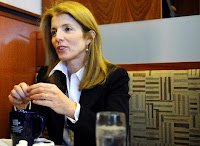

First question is why the gumption by Ms. Kennedy to even venture? Actually, is is quite predictable and happens all the time. In business terms is is simply extending the brand. Many companies attach their popular brand identity to new products or ideas all the time in hopes of taking advantage of that brand's equity. Did you know that Dial not only has its leading bar soap product but sells a deodorant (at least used to) by the same name? Dole became famous for its pineapples . . . or was it bananas or peaches or . . . In extending brands they also run the risk of diluting them.


In politics the branding is fundamental. It is Hillary Clinton, not Hillary Rodham. It is Caroline Kennedy not Caroline Schlossburg (or something like that). The appeal and name recognition is a politicians gold. But like any product or company brands, political brands can overreach. People associate Dial as being a soap not a deodorant. Consumers can be attracted by known brands -- the Kennedy magic would seem to be a case in point. Paradoxically, they are pretty savvy in rejecting these known brands when they overreach into areas they lack competence.


Since John and Bobby Kennedy forged the brand in the 1960s (sowed by their father well before then), the Kennedy family and name has remained intriguing (see this Emery piece that lays out the brand dilution well). But it doesn't mean that people will always buy it. Ted, while loved in his home state, has only marginal national standing (including a failed run for the presidency). Other third generation Kennedies have fizzled when trying move beyond local politics. And I suspect Caroline will have a hard time making traction. People will want to give her a chance, but they also know she lacks some basic qualifications. Despite the rash of political dynasties in the making the American way is still one of merit.

Monday, December 15, 2008

Woe to be Rich

It is a bear to be rich these days. Take Harvard University, which reported losses of $9 Billion to its lofty endowment just in the third quarter. This amount is greater than the sum of the endowment funds for all but the most affluent universities. Running the Harvard endowment (i.e., managing the funds)was one of the most prestigious jobs in finance. Looks like Harvard was playing the risk reward game and got stung like many other common folk.

This week we learn of Bernard Madoff who has now made lots of rich people very mad. Amazingly, he was able to garner over $50 billion of investments from a number of well heeled investors only to use it for big Ponzi scheme. Many of these investors now are on the hook to lose most if not all of their investment. Interestingly, Mr. Madoff is the ultimate charmer, getting all kinds of people to trust him enough to put millions of their dollars in his hands. You can read about Madoff's ruse here. Seems that many people get sucked into presitious opportunities and are shamed to investigate lest they come off as a mere miser. I think it is called snob appeal.

Perhaps, the investors in Madoff's scheme need their own government bailout . . . consider that many of the victims of the scheme are charities and foundations. Madoff built his reputation in part on linking with charities. Many are now the victim of "friendly fire."

Tuesday, December 9, 2008

Ethics, Ethics . . .

Of course the big news today is the sitting governor of Illinois being arrested for trying to "sell" Barack Obama's now vacated Senate seat. This on the heels of senator Ted Stevens being convicted of corruption and Charles Rangel of New York not far behind. At least the voters of Louisiana voted out William Jefferson--the congressman who happened to have $90,000 just sitting around (Alaska did the same to Stevens). But this is not the story on ethics I want to explore. These "gentlemen" did not have ethical lapses as much as they simply engaged in criminal activity (fraud, conspiracy, and corruption is not an "ethical lapse").


John Thain, the most recent CEO of Merrill Lynch -- swallowed up by Bank of America at the height of this Fall's financial meltdown, reportedly asked for a bonus of $10 million. I am sure the consensus among the punditry and people at large is that Thain getting a bonus is outrageous considering that the value of the stock has gone from about $60 to $15 over the course of his tenure. Is it ethical for Thain to even think he deserves a bonus?


Well, actually maybe. Here is one pundit who says Thain deserves it because he saved the company (and thousands of jobs in the process). In fact, some reporting back in September chronicled how well Thain actually performed in saving a company that was in serious trouble when he took over a year ago. Compared to some of his counterparts at Bear Stearns and Lehman (Mr. Fuld make a nice comparison), Thain was very good in a very tough situation. Thain has evidently accepted the Board's decision not to grant a bonus, but the decision may be more one of public relations than actual lack of merit.


Fraud and corruption are not hard to evaluate or condemn . . . the ethics of compensation and many other business decisions are prone to debates more difficult to evaluate.


Wednesday, November 5, 2008

Coach Tocco


This weekend our men's soccer team hosts the GLVC tournament, with the Hawks earning their spot as host based on a stellar record this season. In fact, they have lost only one game this year and won several conference awards.


Having a winning Hawks soccer team is not unusual -- hasn't been for nearly 40 years as Rockhurst has the winningnest active collegiate soccer coach in the county. That's right, no current coach has won more games -- 564 wins! His players call him coach, but I have known him for the past 14 years as Dr. Tocco, or just Tony.


You see as good a coach as he is, Dr. Tocco is a better Accounting professor, where I see his work most. I have had the privilege of working with him on courses (even though I only dabble in accounting) and co-authoring articles with him. As a colleague he is just about as reliable as running water.


I am quite glad to know and work with Dr. Tocco and often forget that he has this other life as a top-flight coach -- as durable as Bobby Bowden and Eddie Robinson. When in his office on 3rd floor Conway--where you will find him just about every day--you would never know he has even played a game. In fact, I have never heard him talk about one of those 564 wins; you just about have to pry it out of him.


This time I have no excuse to ignore his game -- it is right here at Rockhurst this weekend. Best of luck Coach Tocco!

Saturday, October 25, 2008

Newspapers and Bias


I am always amazed at the reach of our Helzberg School to the local business community. This week, the School (thanks to Turner White and John Meyer) put together quite a panel of local journalists to discuss the role of the media in the election -- part of the HSOM's Center for Leadership and Ethics speaker series. The subject of bias was discussed.

Mark Zieman, a recent alum of our Executive Fellows, spoke earlier today to our current Fellows class on the state of the newspaper industry. Zieman is a good person to talk about it -- he was 10 years editor at the KC Star and is now for the last year or so Publisher for the Star. Mr. Zieman talked to the class about the challenges of the industry, pointing out the profound impact of things like the internet and the economy on the newspaper business.
The issue of bias also came up in the discussion today. In fact, the topic brought on a debate between Randy Schwering and I on that topic and others, which made me think on the current politcal issue of elitism . . .

Sunday, October 19, 2008

Flu Shots

Political partisans often throw barbs of anti-Americanism at their opponents. Often this is directed on topics of war and about how America is represented in the world. Many rightly argue that simply criticizing our country is not anti-american nor unpatriotic.

But Americans seem to be non-partisan in their dislike of laws that mandate their individual choices, especially regarding their health. New Jersey passed a law--from the state's public health commission--mandating all pre-school children must get a flu shot to attend any of these schools. The response has been predictable. Reports the AP, "Opposition to the policy is vehement."

Said one of the organizers of the rally against the vaccine law, "This is not an anti-vaccine rally — it's a freedom of choice rally." Americans tend to value individual choice more than the more abstact public benefit . Efforts to take choice away from families on vaccines may be the real anti-Americanism.

Saturday, October 11, 2008

Insanity of Markets

After the crazy week we just had, I wonder the same thing as this person in his op-ed in the NY Times. Despite the genius of the market it does lose its equilberium sometimes. Like it did this week. So where does the fault lie -- with the markets or the government? And there are many opinions on both sides -- here is one defending the market -- which makes it hard to know the answer.

I have some ideas. The problem with markets is very simple: people are involved. Markets are by intent impersonal, set up to allow actors to pusue their own self-interest. People are smart and ingenious and will try to outsmart the market [way oversimplified here because the market is more than just . Amazingly, the market is quite resilient but sometimes gets too far out of whack. Those in charge of regulating these markets (people, again) try to get it out of whack. These regulators "acting for the people" are trying to balance competing goods. These goods are inevitably political and ideological.

Often these prescriptions are counterproductive to the market or the market is counter to them. For example, a strong belief in equity (sometimes called justice) leads to government action that mitigates inquitable market effects. An impersonal market will always be inequitable from the perspective of certain actors at certain times.

I suspect people are distrusting the market right now -- trillions of dollars of stock value have vaporized, much of it retirement money. The question is will we move towards more government control and intervention? Fortunately, I have a lot of colleagues here in the Helzberg School who can help me understand finacial system that is so out of whack (and affecting everything else) right now.